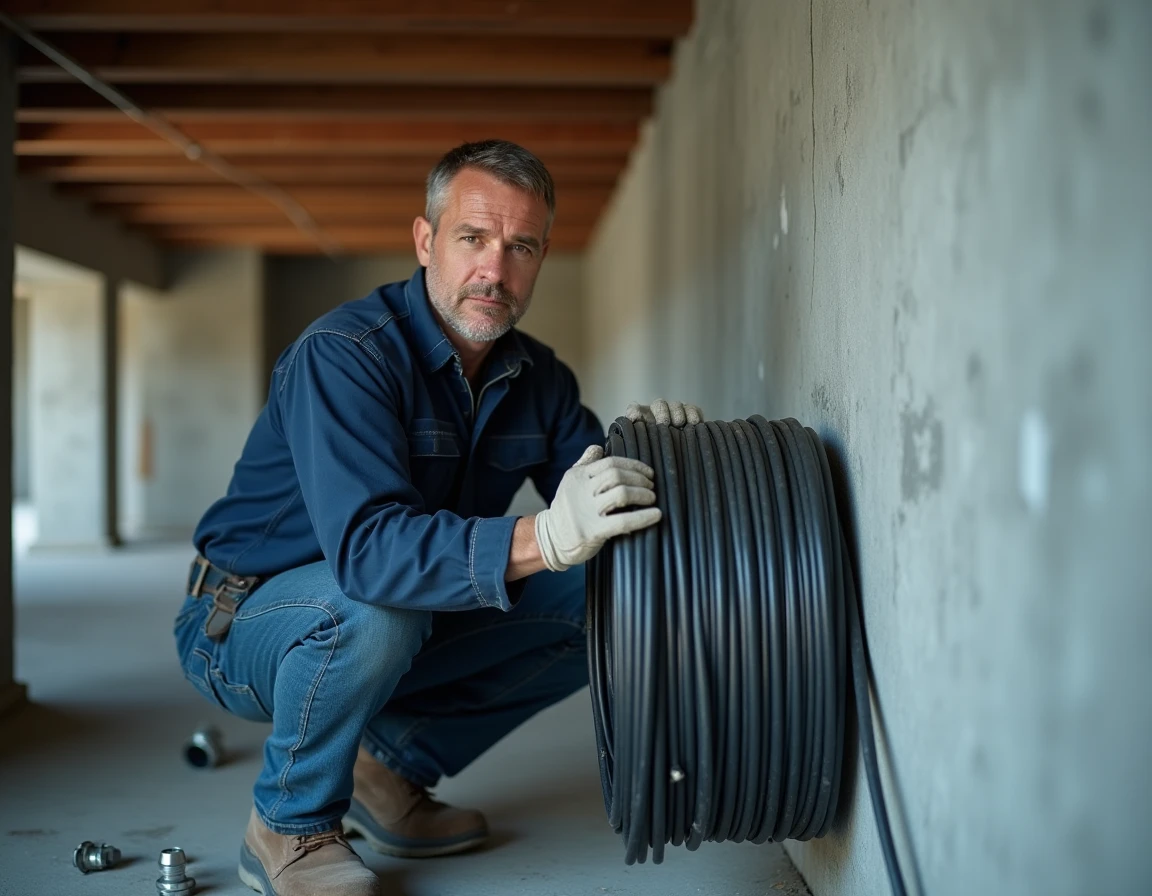
On a a renovation site or in a new house, the R2V cable remains the reference for fixed circuits in low voltage. Its double PVC insulation allows it to be installed without conduit in certain configurations, but this flexibility of use does not exempt from following precise routing rules. If poorly sized or improperly secured, an R2V cable can cause overheating, a voltage drop in the circuit, or even a fire in a construction void.
R2V or halogen-free cable: which cable to choose according to the building
When preparing an electrical installation, the reflex is to order R2V in the appropriate size and move on. This reflex works in a single-family home or a standard technical room. But as soon as one intervenes in a public building (ERP) or a high-rise building (IGH), the question of fire behavior changes the game.
The R2V cable uses a PVC sheath that, in the event of a fire, releases opaque and corrosive smoke. In a hospital corridor or a stairwell of a collective building, this smoke complicates evacuation and damages neighboring equipment. That is why ERPs and IGHs require halogen-free cables, such as the FRN1X6G3, whose sheath releases smoke with low opacity and no acidic gas.
To install an R2V cable safely, one first checks the type of building and the planned routing. The R2V is perfectly suitable for residential use, in annex rooms, or for buried installation under TPC sheath. The halogen-free cable takes over in collective sleeping areas, underground parking lots, and vertical technical shafts of IGHs.
In practice, on a mixed site (a shop on the ground floor with apartments above), one can encounter both types of cables in the same distribution board. The tipping point is the routing: as soon as the cable crosses an area where the public circulates or sleeps, one switches to halogen-free.
R2V cable section: sizing based on circuit length
The conductor section is the parameter that concentrates the most errors on the ground. The section is often chosen based on the circuit breaker rating, which is a good starting point but insufficient when the circuit exceeds a few dozen meters.
Voltage drop, an overlooked constraint on long circuits
The NF C 15-100 standard sets a maximum allowable voltage drop between the panel and the point of use. On a lighting circuit powered in single-phase, this limit requires increasing the section as the length increases, even if the power drawn remains modest.
The calculation approach follows a logical sequence: start from the power of the device, deduce the current (P divided by voltage), then cross this current with the circuit length to check that the voltage drop remains within limits. If it exceeds the limit, one moves to the next higher section.
A common case: powering a gate or garden lighting several dozen meters from the panel. With a 3G1.5 mm² R2V cable, the voltage drop can exceed the allowable threshold. One then switches to 3G2.5 mm² or even 3G4 mm² depending on the distance and load.
Correspondence between section, circuit breaker, and current usage
The standard imposes minimum associations between section and protection rating. Feedback varies on some borderline cases, but the logic remains the same: the circuit breaker protects the cable, not the device.
- Lighting circuit: section 1.5 mm², circuit breaker suitable for the rating specified by the standard, limited in the number of light points per circuit.
- Standard power outlets: section 2.5 mm², with a maximum number of sockets per circuit defined by NF C 15-100.
- Specialized circuits (oven, hob, water heater): section starting from 4 or 6 mm² depending on the power of the device, each circuit dedicated to a single piece of equipment.
Installation of the R2V cable: common routing errors on every site
The installation of the R2V cable seems simple, but it is in the details of the routing that non-conformities accumulate.
Passage in construction voids and securing
The R2V can be installed directly exposed, embedded, or pulled through a construction void (false ceiling, hollow partition). In this last case, the cable must be secured or held so that it does not rest on combustible material without protection. Cable ties or metal cable trays are used to avoid prolonged contact with thermal insulation or wooden framing.
The classic error: leaving the cable lying freely on mineral wool panels in a false ceiling, without any securing. In case of overload, the cable’s heat is not dissipated properly.
Buried installation and mechanical protection
Outdoors, the R2V is buried under red TPC sheath at a minimum depth of 50 cm under a lawn, more under a trafficable area. The cable is laid on a sand bed, then covered with sand before unrolling a red warning mesh.
- Sand bed at the bottom of the trench to avoid stones that could damage the sheath.
- Red TPC sheath of sufficient diameter to pull the cable without forcing.
- Warning mesh placed at mid-height of the backfill, visible during any future excavation.
- Marking the route on a plan, kept with the installation file.
Connection to the electrical panel: precautions for commissioning
The connection of the R2V cable to the panel is the last step, but it concentrates risks if working under voltage or neglecting tightening.
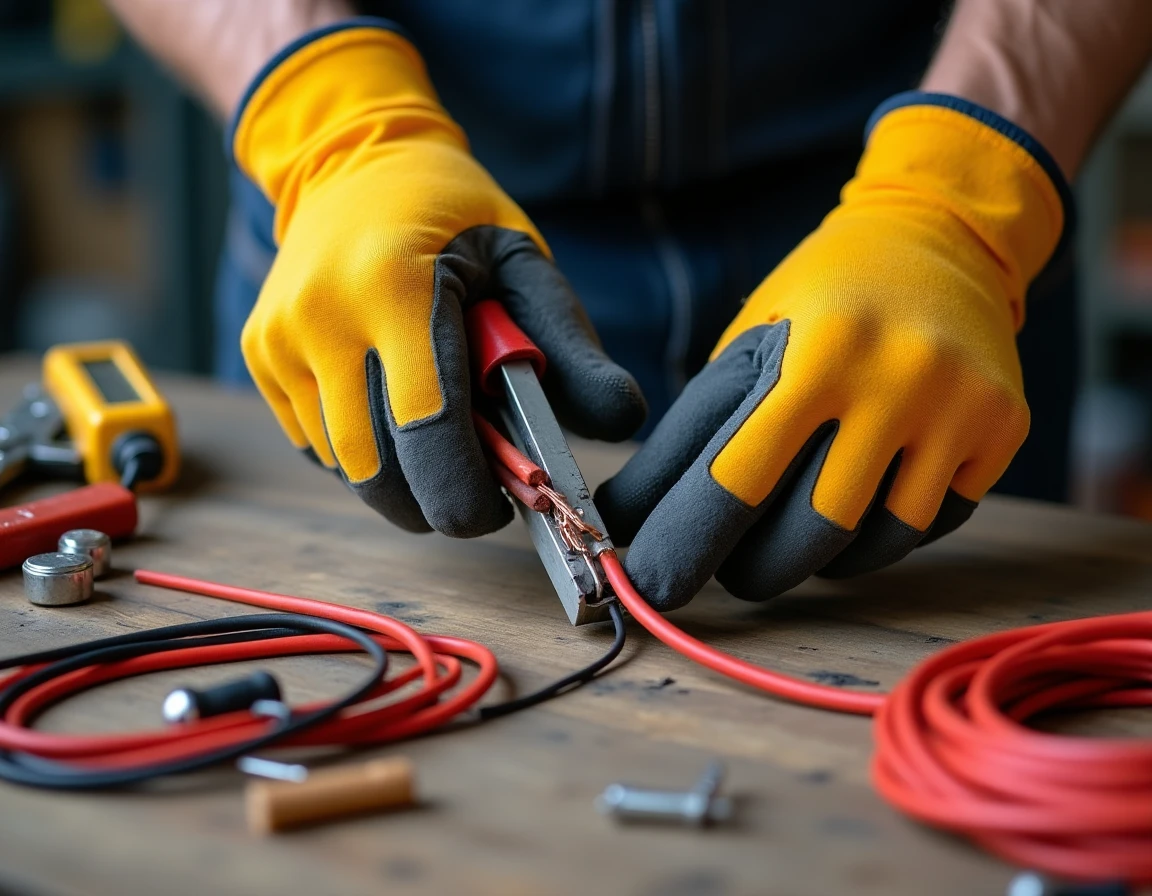
The main power supply is cut off at the connection circuit breaker. The stripping of the outer sheath is done with a retractable blade cutter, making a longitudinal incision without cutting into the insulation of the inner conductors. An injured insulation is a future insulation defect, often invisible at the time of installation.
The conductors are connected to the circuit breaker terminal or the ground terminal of the panel. The tightening is checked according to the torque recommended by the equipment manufacturer. Insufficient tightening causes a hot spot that can melt the plastic of the circuit breaker after a few months of operation.
Before re-energizing, an insulation test between live conductors and the ground conductor allows for detecting a sheath defect or accidental contact. On new installations, this check is part of the Consuel diagnostic. On an extension, it is a verification done by oneself with a megohmmeter, or entrusted to an electrician.
The R2V cable remains a reliable and economical product for the majority of residential installations. The choice between a halogen-free cable is based on the type of building and the cable route, not on a question of quality. Properly sizing the section, respecting burial depths, and ensuring the connection to the panel: these three points cover the vast majority of defects observed during compliance checks.