
A pool without a skimmer operates on a distinct hydraulic principle: the water level is flush with the coping and overflows into a channel or a peripheral buffer tank. This is not just a simple aesthetic gadget. The surface water recovery changes the filtration dynamics, the design of the technical room, and the sizing of the pump.
Water recovery by overflow: what it changes in the hydraulic circuit
In a traditional circuit, the skimmer draws surface water through a calibrated opening. Removing this component means replacing the point recovery with a linear recovery around the entire perimeter of the pool. The water crosses the edge, falls into a channel (or trough), and joins an underground buffer tank before being sent to the filter.
The buffer tank acts as a volume regulator. Each swimmer entering the pool causes a displacement of water. Without a skimmer, this excess volume must be absorbed somewhere. An undersized tank leads to uncontrolled overflow onto the ground, or even pump loss of prime when the level drops too low.
We recommend sizing the buffer tank to at least the volume of water displaced by the maximum expected attendance, plus a safety margin. The capacity of the tank directly conditions the stability of the filtration circuit.
To fully understand how a pool without a skimmer works, this constraint must be integrated from the design phase of the pool, not as an afterthought.
Surface filtration without a skimmer: real effectiveness on floating pollutants
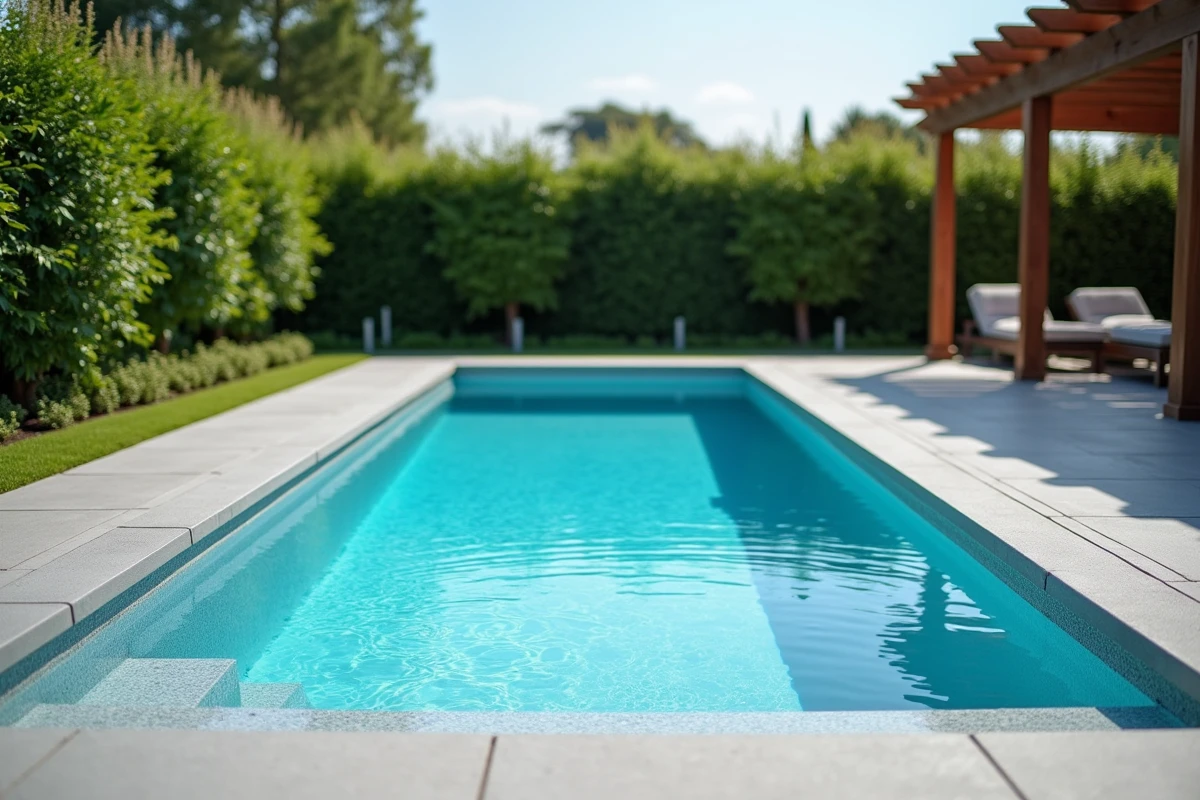
The majority of pollutants in a pool concentrate in the first few centimeters of the surface. Pollen, insects, sunscreen, dust: everything stagnates at the top. The skimmer addresses this issue by locally sucking a thin layer of water. The overflow, on the other hand, captures this layer across the entire perimeter.
On paper, the overflow is more effective. In practice, effectiveness depends on the regularity of the edge. A level defect of a few millimeters on the coping creates a dead zone where the water no longer overflows. Pollutants accumulate there.
We observe that well-constructed overflow pools offer significantly cleaner surface water than skimmer pools, provided that the construction is impeccable. The slightest settling of the ground or masonry defect compromises the result.
Maintenance of the buffer tank and the channel
The buffer tank accumulates debris captured from the surface. It requires regular cleaning, unlike the skimmer basket that can be emptied in a few seconds. The peripheral channel can also become clogged, especially in a garden with nearby trees. This additional maintenance point is rarely mentioned in sales pitches.
Pump and energy consumption: a often underestimated aspect
An overflow circuit requires the pump to lift water from the buffer tank, located below the pool. The total dynamic head (TDH) increases compared to a circuit with a skimmer, where the recovery occurs at mid-height of the wall.
This additional TDH translates into higher electricity consumption. At equivalent filtration flow rates, the pump works harder. Over a full swimming season, the difference in the electricity bill is noticeable.
- The buffer tank should be as close as possible to the technical room to limit pressure losses in the pipes.
- A variable speed pump allows adapting the flow to real conditions (number of swimmers, water temperature) and reduces overconsumption.
- The diameter of the pipes between the channel, buffer tank, and pump must be carefully calculated to avoid undersizing that would strain the pump.
A pool without a skimmer consumes more in pumping energy than an equivalent pool with skimmers, at comparable filtration quality. This is a trade-off that should be clearly established before validating the project.
Pool without a skimmer: construction constraints and real cost

The removal of the skimmer does not simplify construction. It complicates it. The edge of the pool must be perfectly level around the entire perimeter, which requires millimeter-level leveling precision. On clay soil or sloped terrain, ground movements can disrupt the entire setup after a few seasons.
The construction cost of an overflow pool significantly exceeds that of a skimmer pool of comparable dimensions. The buffer tank, channel, additional pipes, and more powerful pump increase the budget.
- Excavation of the buffer tank (volume, waterproofing, access for maintenance).
- Machined or cast coping with very tight level tolerances.
- Dedicated hydraulic network between the channel and buffer tank, distinct from the return circuit.
- Automatic water level regulation (solenoid valve, sensor) to compensate for evaporation and rainwater influx.
A poorly designed overflow pool generates more problems than a well-installed skimmer pool. The choice is not aesthetic; it is technical.
Hybrid alternatives: keeping a skimmer while improving the surface
Some builders offer wide-opening skimmers or adjustable floating flap skimmers that increase the surface capture area without requiring a buffer tank. These intermediate solutions allow for capturing more floating pollutants while maintaining a traditional hydraulic circuit.
Another approach is to combine a classic skimmer with a decorative water blade on one side of the pool. Partial overflow improves surface renewal in the area most exposed to the wind (and thus to deposits), without imposing the complexity of a complete peripheral overflow.
The choice between a pool without a skimmer and an improved classic pool depends on the terrain, budget, and the owner’s tolerance for maintaining the buffer tank. The overflow pool is not a myth, but it remains a demanding technical solution that does not forgive approximation during the construction phase.