
You have been drawing for years, you have mastered the basics of color and composition, and you are considering making it your profession. One concrete question remains: should you lean towards illustration or concept art? These two disciplines share a common technical foundation, but they lead to very different professional daily lives, with constraints, rhythms, and opportunities that only partially overlap.
Final deliverable or working image: what changes in daily life
The most structuring distinction between the two professions lies in the very nature of what you produce. An illustrator creates an image intended to be seen by the public. It appears in a book, a magazine, a poster, or packaging. It must stand alone, be readable, and be complete.
A concept artist, on the other hand, produces an image that will never be published as is. Their visuals serve as a guide for a production team: 3D modelers, animators, level designers. Concept art is an internal communication tool, not a final work.
This difference has immediate consequences on the relationship with time. An illustrator can spend several days on a single image, refining the details. The concept artist sometimes churns out several proposals in the same day, in the form of quick sketches or color variations.
To choose between illustration and concept art based on your profile, this question of production rhythm is the first criterion to evaluate honestly.
Technical skills in illustration and concept art: a common foundation, divergent specializations
Drawing, anatomy, perspective, color theory, composition: these fundamentals are shared. But as soon as we go beyond this common core, the paths diverge.
What concept art requires in addition
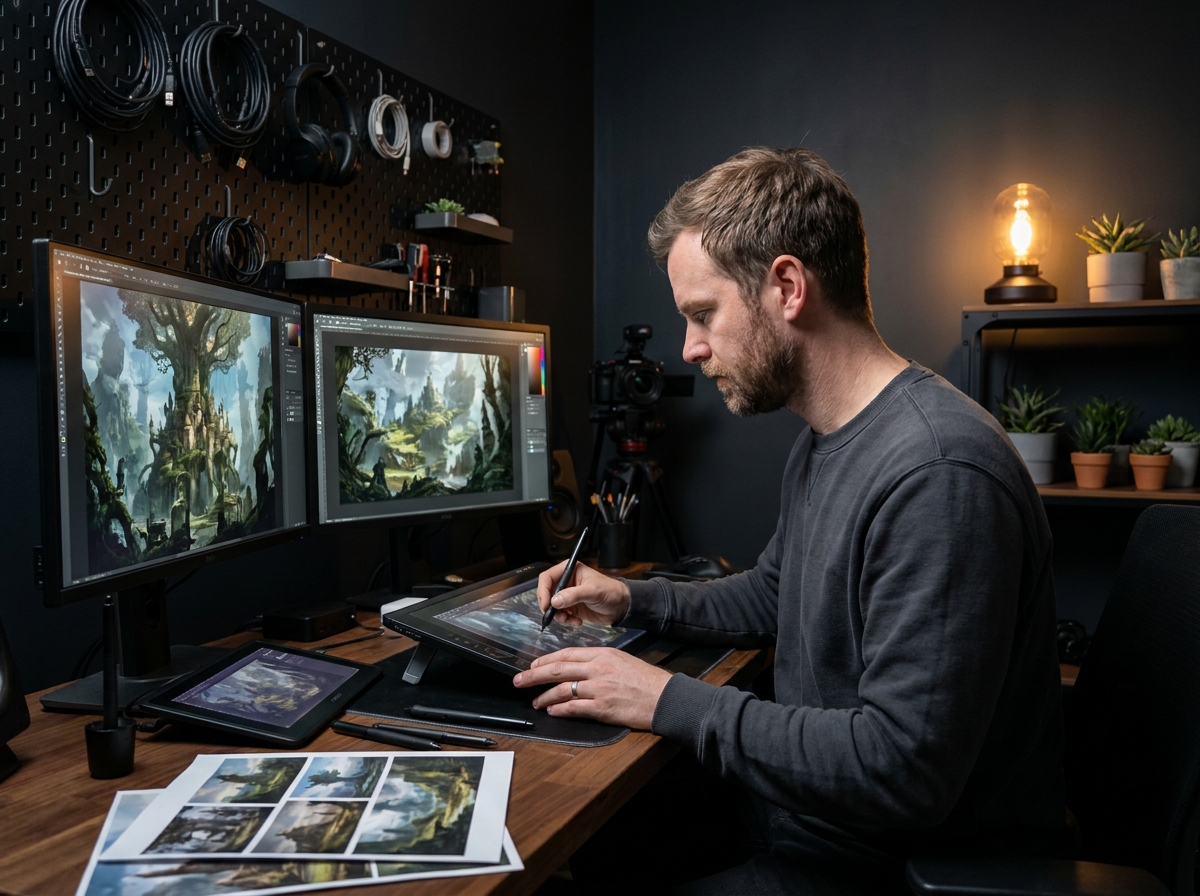
The concept artist increasingly works with 3D tools like Blender, ZBrush, or Unreal Engine. Studios expect profiles capable of creating quick 3D “blockouts” to propose realistic volumes and lighting even before painting. This technical skill is added to the mastery of traditional drawing.
In recent years, generative AI tools have also entered the concept artist’s workflow, not to replace drawing, but to speed up the research phase. Generating thumbnails, exploring palettes, producing mood boards: these tasks require a capacity for visual direction and critical sorting that software alone does not provide.
What illustration requires in addition
The illustrator must master visual storytelling. A single image must tell something, convey an emotion, guide the viewer’s gaze without accompanying text. The finish matters greatly: textures, details, stylistic consistency from one project to another.
The editorial dimension also weighs in. A children’s illustrator, for example, adapts their style to an age group, a book format, or a printing constraint. The illustrator is responsible for the final rendering, whereas the concept artist delegates this responsibility to the production team.
Professional status and opportunities: freelance or studio
Do you enjoy working alone, managing your projects, choosing your clients? Illustration lends itself well to freelance status. The majority of illustrators work independently, with assignments for publishing, press, advertising, or the web.
Concept art, on the other hand, is primarily practiced in studios. The video game, animation film, and audiovisual production sectors hire concept artists internally or on long-term contracts. Teamwork is a daily occurrence: art direction meetings, iterations with other professions, adherence to a production pipeline.
Here are the main criteria to weigh before you decide:
- Tolerance for rapid iteration: concept art requires producing quickly and accepting that most of your proposals will be discarded. If you need to take each image to a high level of finish, illustration will suit you better.
- Relationship to the collective: in a studio, your images are commented on, modified, sometimes redrawn by others. In freelance illustration, you retain more control over the outcome, even if the client brief remains constraining.
- Affinity for 3D techniques and advanced digital tools: if manipulating Blender or ZBrush intimidates you, contemporary concept art may frustrate you. Illustration remains more accessible with 2D tools alone (Photoshop, Procreate, Clip Studio Paint).
- Type of training pursued: a course in 2D/3D animation or game art naturally leads to concept art. A DN MADE, an applied arts school, or a self-taught path focused on publishing leads more towards illustration.

Hybrid profiles in concept art and illustration: the boundary blurs
In small and medium-sized structures, the clear separation between concept artist and illustrator tends to disappear. Small studios seek artists capable of producing both working concept art and final marketing illustrations: key art, promotional visuals for social media, covers.
Many professional portfolios now mix both types of work. This versatility becomes a competitive advantage in the job market, provided that quality is not sacrificed in either discipline.
A solid hybrid profile masters rapid visual research (sketches, explorations) as well as editorial finishing. It’s demanding, but it’s also what opens the most doors, especially in independent video game studios where one person can move from graphic brainstorming to creating key art in just a few days.
The choice between illustration and concept art is not definitive. Skills transfer, career changes exist, and the market increasingly values artists who can navigate between the two. What matters is to start with the path that aligns with your natural way of working, then broaden your palette over the course of your projects.