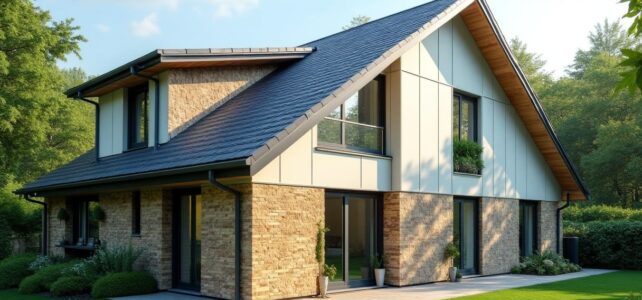
In the face of current energy and environmental challenges, optimizing building insulation has become an undeniable priority. Among the solutions that stand out for their effectiveness and relevance, external insulation emerges as an essential technique to improve the energy efficiency of homes while providing significant aesthetic benefits.
This method offers a multitude of advantages that appeal to both individuals and professionals. It not only significantly reduces heat loss but also ensures optimal thermal comfort throughout the year. External insulation provides a true protective envelope that retains heat in winter and coolness in summer, while also contributing to the enhancement of real estate value.
The principles of external insulation
To fully benefit from external insulation, it is important to understand its foundations and mechanisms. This method is characterized by the installation of insulating materials directly on the external walls of buildings, forming a continuous thermal barrier.
The materials used for this technique are varied and chosen based on the specific needs of each project. These include rock wool, expanded polystyrene, and polyurethane. Each of these materials has particular characteristics in terms of thermal and acoustic insulation.
By completely enveloping the house, external insulation prevents thermal bridges, those weak areas where heat escapes. Eliminating these bridges contributes to better energy efficiency of the home.
This method also protects the walls from climatic aggressions and temperature variations, thereby extending their lifespan.
Advantages and limitations of external insulation
Adopting external insulation involves carefully weighing the benefits it provides against its potential drawbacks. Analyzing these various aspects offers a useful overview for any decision-making process.
Advantages:
- Significant improvement in energy efficiency, leading to a notable reduction in heating and cooling consumption.
- Maintaining the interior living space, avoiding any loss of space within the home.
- Ease of renovation: this method can be applied without major disruptions for the occupants.
- Possibility of a varied aesthetic finish, ranging from coatings to cladding, to harmonize with the existing architectural style.
Limitations:
- Potentially high initial cost, although quickly offset by the energy savings achieved.
- Need for professional expertise to ensure correct and effective application.
- Regulatory constraints in certain urban areas, particularly for classified buildings or in protected sectors.
The applications of external insulation in France
In France, external insulation is experiencing remarkable growth, reflecting an increasing awareness of energy and environmental issues. The applications of this technique are diversifying, encompassing both renovation projects and new constructions.
- Urban renewal: In historic city centers, external insulation adapts to heritage constraints while improving the energy efficiency of old buildings.
- Residential projects: Individual houses and collective buildings benefit from this method to reduce their carbon footprint and lower their energy bills.
- Extensions and elevations: In the context of expanding living spaces, external insulation ensures harmonious integration with the existing structure.
Regulations and financial aid available
Adopting external insulation involves complying with certain regulations and taking advantage of financial aid offered by the State and local authorities. These measures aim to encourage energy renovations and support households in their transition to more ecological habitats.
In terms of regulation, the 2020 Thermal Regulation (RT 2020) sets energy performance requirements that external insulation easily meets. These standards are designed to ensure optimal thermal quality of buildings, thus contributing to the goal of carbon neutrality.
Among the financial aids available, there is the tax credit for energy transition (CITE), which offers significant tax relief for insulation work. Other measures such as the zero-interest eco-loan and grants from the National Housing Agency (ANAH) provide considerable financial support.